Buying a new console game is no longer a simple decision. Prices are higher, releases are more frequent, and reviews often fail to reflect how a game actually feels once the controller is in your hands. For many players, the risk is not wasting money, but wasting time on an experience that never truly clicks.
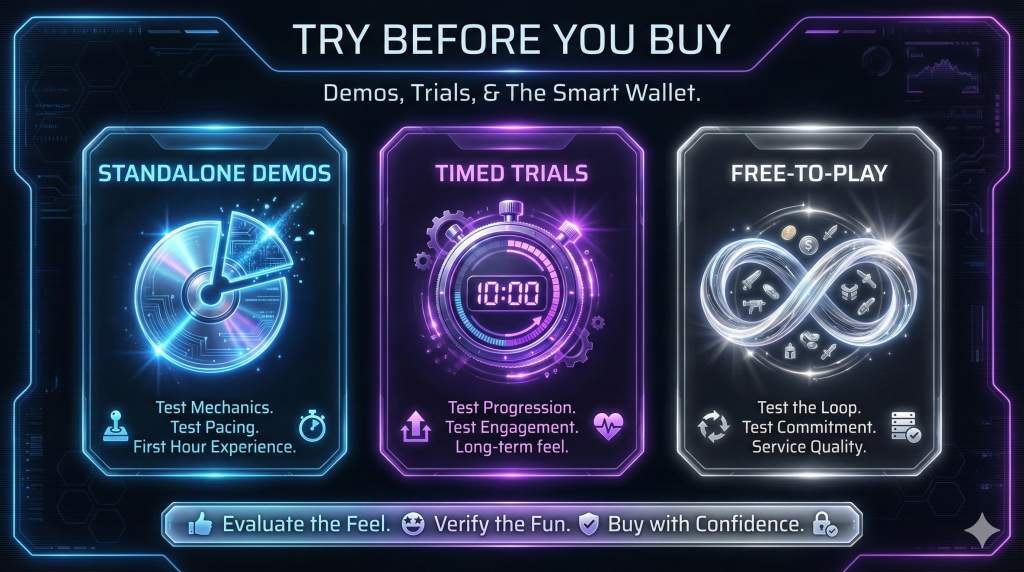
Modern consoles offer a practical solution. Through playable demos, timed trials, and free-to-play entry points, you can evaluate a game’s mechanics, pacing, and presentation before committing to a purchase. These options vary widely in how much they reveal, and knowing which to use can make the difference between a confident buy and instant regret.
This guide breaks down the most valuable console games to try before buying, explaining what each demo or trial actually tells you about the full experience. The goal is not to sample everything, but to test the right games in the right way so your next purchase fits how you play.
Key Takeaways
- Standalone demos are best for evaluating core mechanics and first-hour pacing.
- Timed trials are the most reliable way to judge long-term engagement and progression systems.
- Subscription trials work best for genre testing, not for deciding on short narrative games.
- Free-to-play titles are ideal for assessing live-service commitment and gameplay loops, not story depth.
- The best way to avoid regret is matching the trial type to what you care about most: mechanics, time investment, or replay value.
Affiliate Disclaimer: Some links on this site are affiliate links. If you buy through them, we may earn a small commission, at no extra cost to you. Please do your own research before making a purchase.
Ranked Console Games to Try Before Buying
The table below ranks console games based on how effectively their demo, trial, or free access helps you judge the full experience. This is not a quality ranking of the games themselves. It reflects how much confidence each trial gives you before spending money.
| Rank | Game | Best Way to Try | What the Trial Tells You |
|---|---|---|---|
| 1 | Final Fantasy VII Rebirth | Standalone demo | Shows real combat pacing, party switching, and exploration flow within the opening hours |
| 2 | Stellar Blade | Standalone demo | Confirms whether timing-based combat and difficulty curve suit your reflexes |
| 3 | Resident Evil: Requiem | Standalone demo | Tests tolerance for tension, resource pressure, and horror pacing early |
| 4 | EA Sports FC | EA Play timed trial | Reveals long-term engagement across modes rather than first-match impressions |
| 5 | Destiny 2 | Free-to-play | Evaluates shooting feel, co-op structure, and live-service loop before expansions |
| 6 | Final Fantasy XIV | Free trial | Shows pacing, combat cadence, and MMO commitment before endgame investment |
How to use this table:
Use it as a shortcut. If a game ranks higher here, it means its trial gives you clearer insight into whether the full experience fits your playstyle. The sections below explain why each option works and where its limits are.
Must-Play Standalone Demos
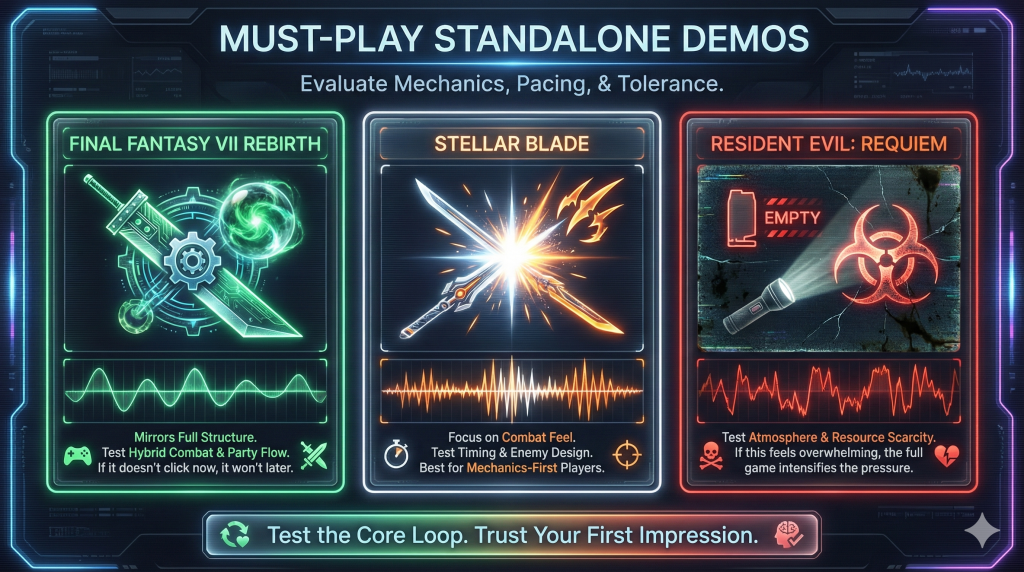
Standalone demos are most valuable when they replicate the opening hours of the full game.
They reveal how combat feels, how systems are introduced, and whether the pacing holds your attention beyond initial spectacle.
Final Fantasy VII Rebirth — Demo
This demo is effective because it mirrors the structure of the full game rather than presenting a disconnected slice.
It allows you to evaluate the hybrid combat system, party switching, and encounter pacing under real conditions.
If the rhythm of exploration and combat does not click here, the full experience will not change dramatically later.
Stellar Blade — Demo
The Stellar Blade demo focuses almost entirely on combat feel and enemy design. It quickly answers whether you enjoy its timing-based combat and difficulty curve.
What it does not fully convey is narrative depth, making this demo best for players prioritizing mechanics over story.
Resident Evil: Requiem — Demo
Resident Evil demos are designed to test tolerance rather than mastery. This preview emphasizes atmosphere, tension, and resource scarcity, which are core to the full game.
If the demo feels overwhelming or frustrating, the complete experience will intensify those same pressures rather than soften them.
Subscription-Based Timed Trials
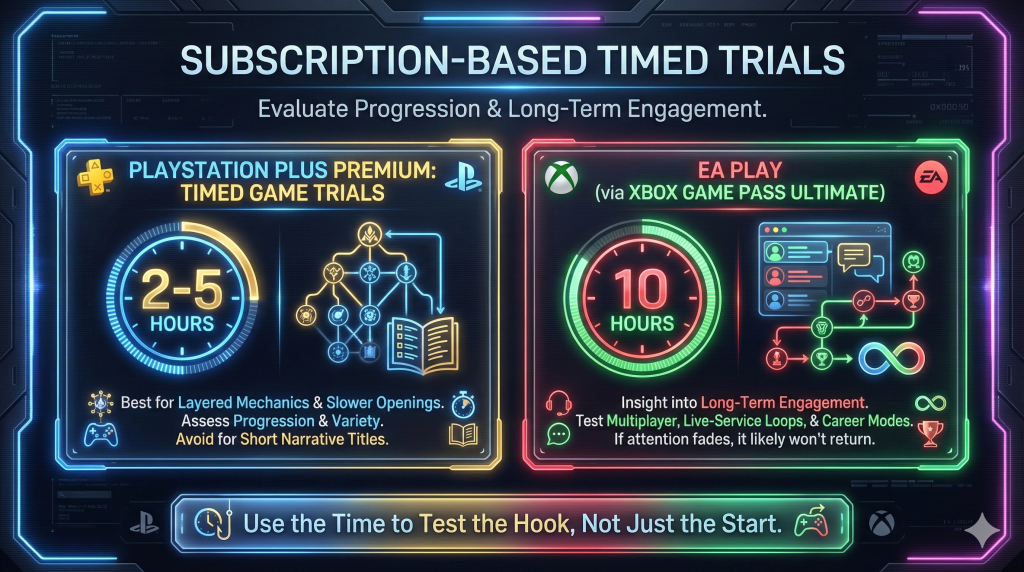
Timed trials are most valuable when a game’s appeal depends on progression rather than first impressions.
Unlike demos, these trials grant access to the full game for a limited number of hours, making them ideal for evaluating systems that only emerge after several sessions.
PlayStation Plus Premium — Timed Game Trials
PlayStation Plus Premium trials are best used on games with layered mechanics or slower openings. Two to five hours is usually enough to assess progression speed, quest structure, and moment-to-moment variety.
These trials are less effective for short, narrative-driven titles, where early exposure may reveal most of what the game offers.
EA Play (via Xbox Game Pass Ultimate)
EA Play’s ten-hour trials provide meaningful insight into long-term engagement. This duration allows you to test multiplayer balance, live-service loops, or career modes without rushing.
If a game fails to hold your attention after several hours, the full experience is unlikely to reverse that impression.
Free-to-Play Entry Points
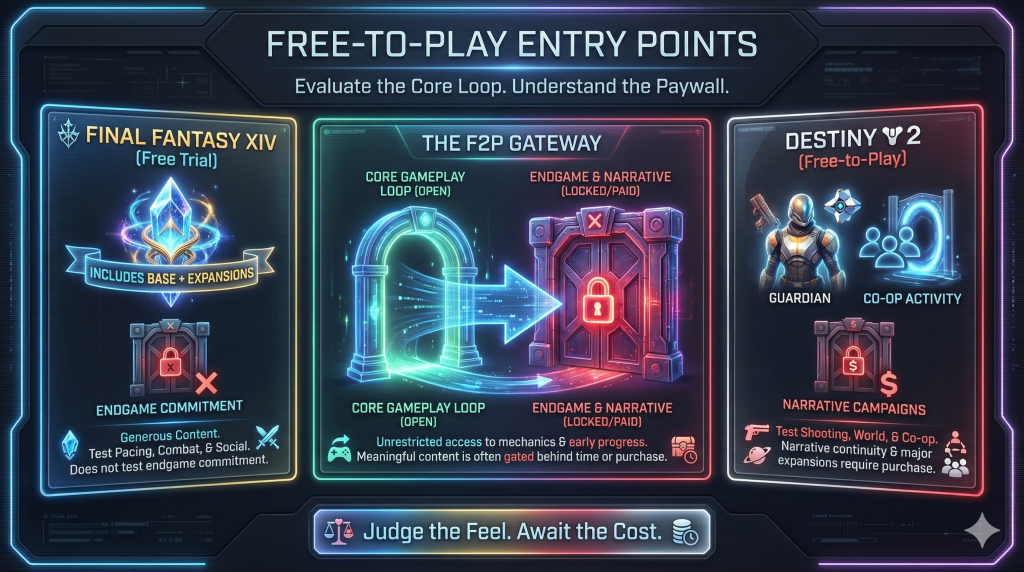
Free-to-play games are best used to evaluate a core gameplay loop and long-term engagement, not narrative completeness.
These titles allow unrestricted access to mechanics and early progression, but they often delay their most meaningful content behind time or purchase gates.
Final Fantasy XIV — Free Trial
The free trial for Final Fantasy XIV is unusually generous, offering dozens of hours across multiple expansions.
It excels at showing whether you enjoy the game’s pacing, combat cadence, and social structure.
What it does not test is endgame commitment, which defines the experience once the trial ends.
Destiny 2 — Free-to-Play
Destiny 2’s free experience introduces its shooting mechanics, world structure, and cooperative activities.
It is effective for judging moment-to-moment gameplay, but less reliable for understanding narrative continuity or long-term content access.
Players should expect meaningful expansions to require additional purchases.
How to Access Demos on PS5 and Xbox Series X
Finding demos and trials is straightforward once you know where each platform surfaces them. Availability changes often, so checking the right sections saves time.
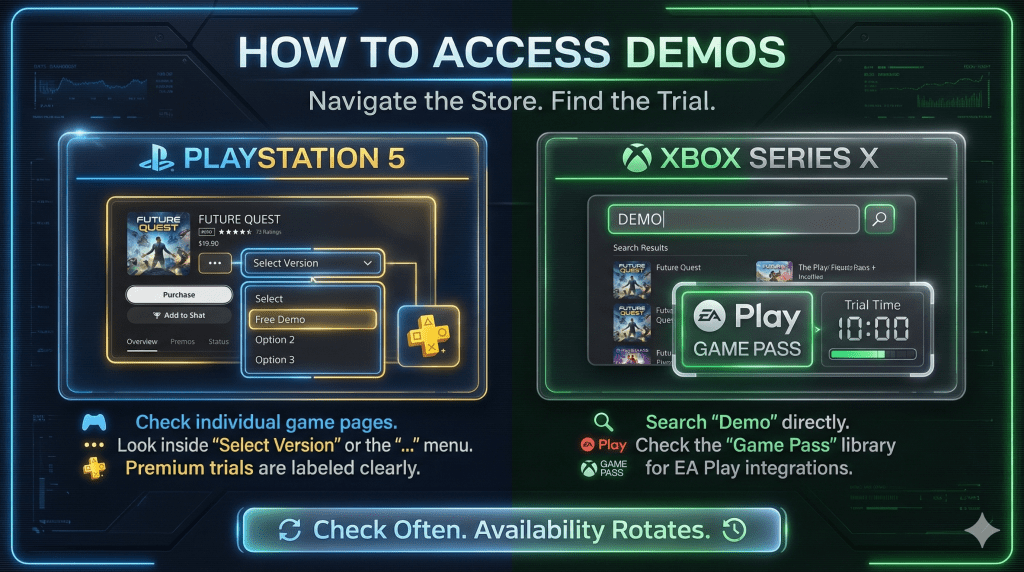
On PlayStation 5
Use the PlayStation Store search to check individual game pages first, since demos and trials are not always grouped consistently.
PlayStation Plus Premium trials appear directly on supported game listings and are clearly labeled with time limits. Standalone demos usually sit under the game’s edition options when available.
On Xbox Series X
The Xbox Store groups demos more reliably. Searching the store for “demo” or browsing the optimized categories surfaces most available trials.
EA Play trials are integrated into the Xbox Game Pass Ultimate library and display remaining trial time once started.
Across both platforms, demos and trials rotate regularly. If a game you are interested in does not currently offer one, checking back around launch windows or major updates often yields better results.
Conclusion
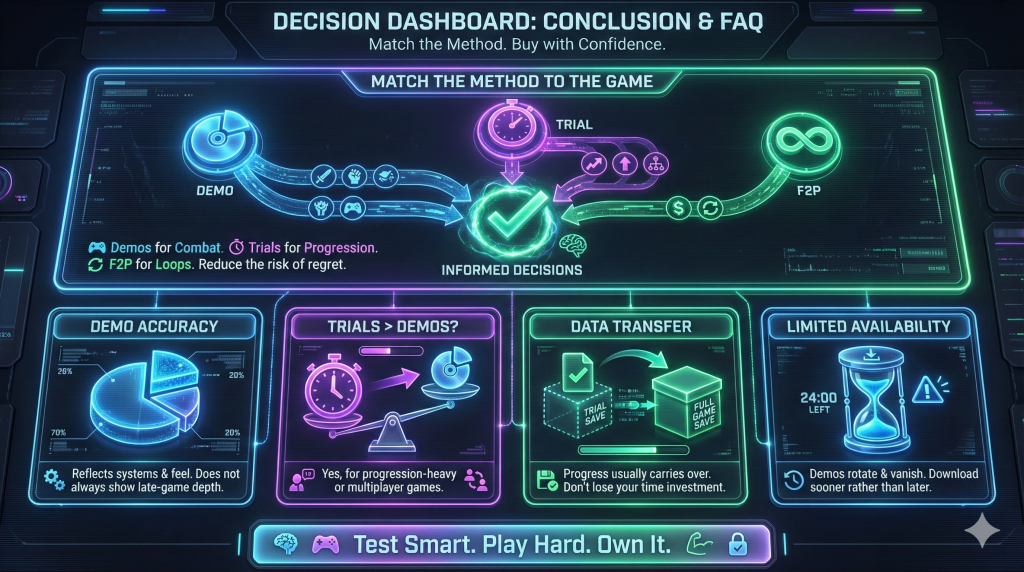
Trying a console game before buying is most effective when the method matches what you want to learn. Standalone demos are best for judging combat feel and pacing. Timed trials provide clarity on progression systems and long-term engagement. Free-to-play options reveal whether a gameplay loop is worth committing to over time.
No single approach works for every game or player. Narrative-driven titles benefit most from focused demos, while system-heavy or multiplayer games require extended trials to evaluate properly. Free-to-play experiences are valuable, but only if you understand where access ends and commitment begins.
By choosing the right way to test a game, you reduce both financial risk and wasted time. The goal is not to try everything, but to make informed decisions that align with how you actually play.
Frequently Asked Questions
Do demos accurately represent the full game?
Most modern demos reflect the final gameplay systems, but not always the full pacing or difficulty curve. They are best used to judge combat feel, controls, and presentation rather than late-game depth or narrative payoff.
Is a timed trial better than a demo?
Timed trials are more useful for games built around progression, multiplayer, or live-service systems. If a game only becomes engaging after several hours, a full-game trial provides far more insight than a curated demo slice.
Will my progress carry over if I buy the game later?
In most cases, yes. Save data from demos and timed trials typically transfers to the full game, provided you purchase it on the same account and platform. Free-to-play progress also carries forward if you buy expansions later.
Are subscription trials worth it if I only want to test one game?
They can be, but only if the trial length matches the type of game you are testing. Subscription trials are less valuable for short, story-driven games and more effective for long-form or replayable titles.
Can demos and trials disappear without notice?
Yes. Availability often changes around launch windows, major updates, or licensing shifts. If a demo or trial is available for a game you are interested in, it is usually best to download it sooner rather than later.


0 Comments