Introduction
Call of Duty: Warzone can feel unforgiving when you first drop in. Matches end quickly, enemies seem to appear from nowhere, and a single mistake can erase twenty minutes of progress.
Unlike traditional multiplayer, Warzone rewards patience, positioning, and smart decisions as much as mechanical skill. Surviving longer is less about chasing kills and more about understanding the systems that control the match.
This guide explains the core mechanics every new player needs to master, from managing the shrinking gas zone to using the economy, securing a loadout, and navigating the Gulag. By understanding how these systems work together, you give yourself a real chance to reach the final circle and win your first match.
Key Takeaways
- The shrinking gas zone controls pacing and forces squads into conflict over time.
- Armor Plates dramatically increase survivability and should be prioritized before fights.
- Cash is a strategic resource that enables redeployments, information, and loadouts.
- The Gulag offers a single second chance, but survival afterward depends on smart positioning.
- Securing a loadout early shifts your squad from reacting to controlling engagements.
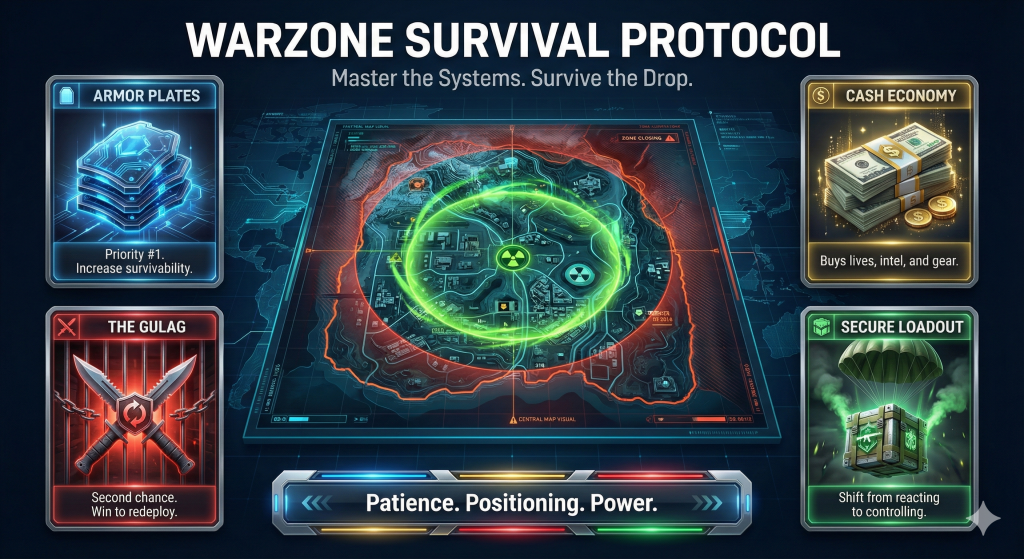
The rules of engagement
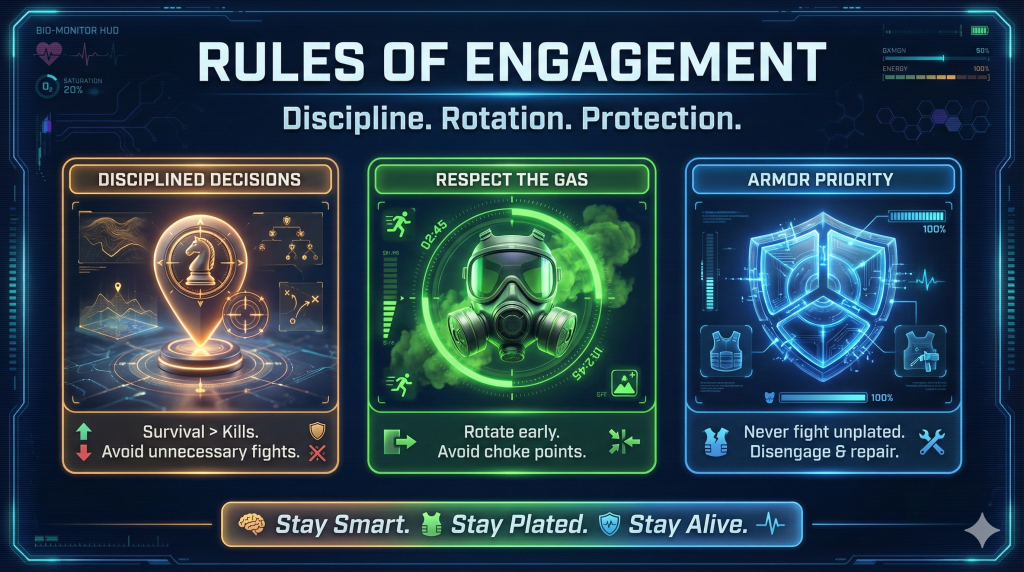
Warzone follows a Battle Royale format where survival is the primary objective. The playable area shrinks over time, forcing squads closer together and increasing the likelihood of conflict.
Unlike standard multiplayer modes, death carries real consequences. Once eliminated, you are removed from the match unless you win a Gulag duel or your squad spends resources to redeploy you.
Because of this, success in Warzone depends less on chasing kills and more on making disciplined decisions. Avoiding unnecessary fights, choosing safe rotations, and staying alive longer consistently increases your chances of reaching the final circle.
The circle collapse and gas
The gas is the primary force that controls movement in Warzone. As the match progresses, it steadily reduces the safe zone and funnels squads into smaller areas.
Remaining inside the gas quickly drains health and destroys armor, making prolonged exposure unsustainable. Because of this, awareness of the circle timer is as important as tracking enemy movement.
Strong survival play involves rotating toward the next safe zone early rather than reacting at the last moment. Early movement allows you to choose safer paths, avoid crowded choke points, and secure stronger positions before other squads are forced to move.
Armor plates and health
In Warzone, armor plates are your primary layer of protection. Your base health alone is not designed to survive sustained gunfire, especially against fully equipped opponents.
Each armor plate significantly increases the amount of damage you can absorb. Entering a fight without full armor puts you at an immediate disadvantage, even if your aim is strong.
Effective survival play means treating armor as mandatory preparation. If your plates are broken, disengage, reposition, and reapply armor before re-engaging. Winning fights in Warzone often begins with entering them fully protected.
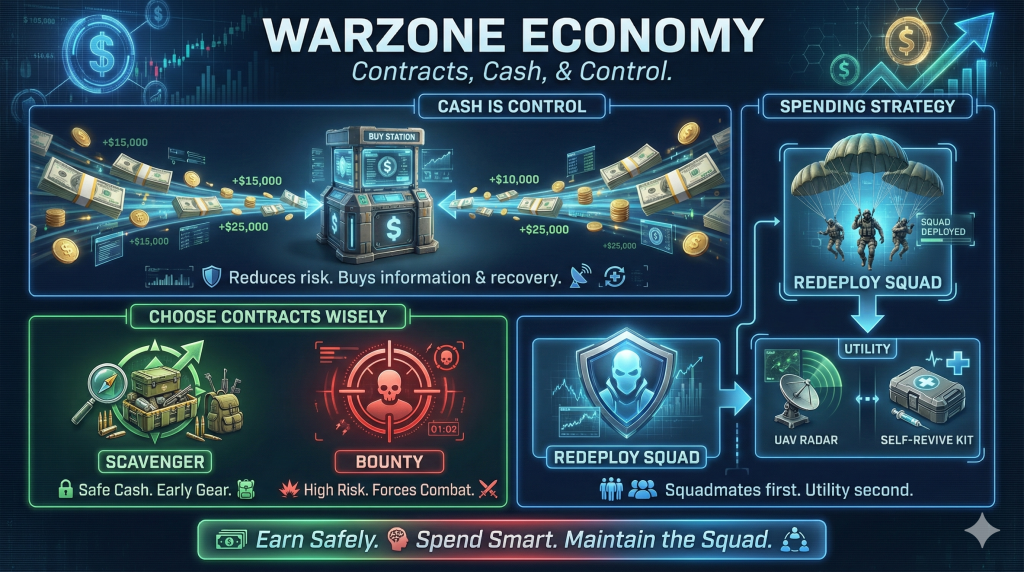
The economy: Contracts and Buy Stations
Warzone’s economy determines how much control your squad has over the match. Cash allows you to reduce risk, recover from mistakes, and gain information rather than relying solely on ground loot.
Squads that collect cash early gain access to Buy Stations, where advantages such as UAVs, Self-Revive Kits, and redeployments become available. These purchases increase survivability and reduce the consequences of losing a fight.
For new players, prioritizing cash collection early creates stability. A squad with resources can recover from setbacks, while a squad without cash is forced to play perfectly or be eliminated.
Completing contracts
Contracts provide structured ways to earn cash and equipment, but not all contracts support survival equally. Choosing the right contract early can stabilize your match rather than force unnecessary fights.
Scavenger contracts are the safest option for new players. They guide your squad to supply crates, reward large cash payouts, and improve your gear without requiring combat. This makes them ideal for early-game economy building.
Bounty contracts identify a nearby enemy squad and reward you for eliminating them. While profitable, they introduce risk by drawing attention and forcing engagements. These contracts are better suited once your squad is equipped and positioned to fight.
Using Buy Stations
Buy Stations allow your squad to convert cash into survival advantages. These locations are where mistakes can be corrected and momentum can be regained.
For new players, redeploying eliminated teammates should be the highest priority. Maintaining squad numbers is more valuable than temporary information or equipment. A full team increases survivability, scouting ability, and late-game presence.
After redeployment, utility purchases become important. UAVs provide short-term map awareness and help avoid ambushes, while Self-Revive Kits offer insurance during unexpected engagements. Spending cash deliberately at Buy Stations turns resources into control rather than desperation.
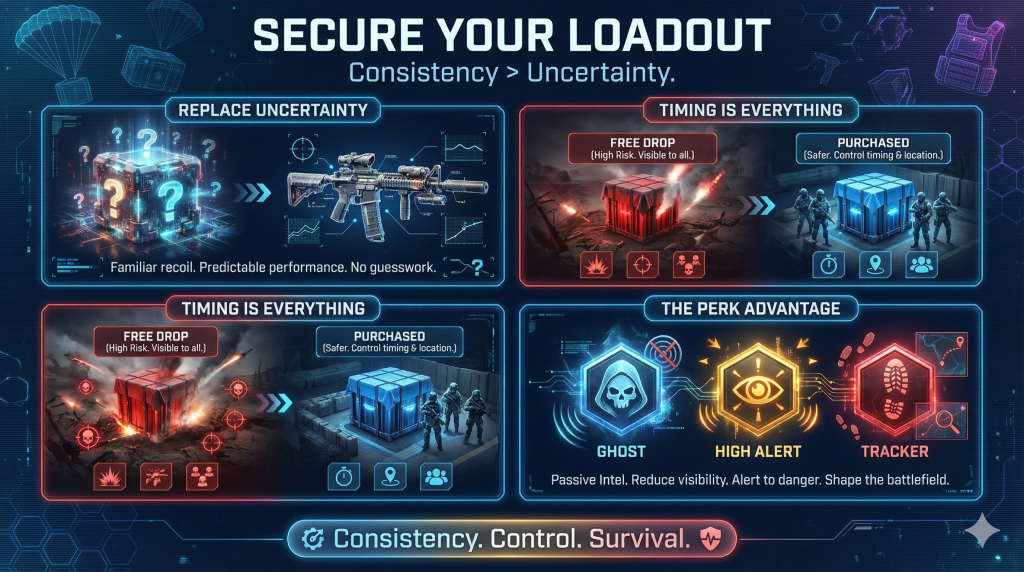
Securing your loadout drop
A loadout drop replaces uncertainty with consistency. Instead of relying on random ground loot, it allows your squad to equip weapons and perks built for your preferred playstyle.
Loadouts matter because they remove guesswork. Familiar recoil patterns, predictable damage ranges, and chosen perks reduce mistakes during high-pressure fights. This reliability often matters more than raw weapon strength.
However, securing a loadout safely is more important than securing it quickly. Poor positioning or rushed decisions can turn a loadout drop into an unnecessary fight that ends your match early.
Timing and acquisition
Warzone offers two ways to obtain a loadout: free drops that appear during specific circles and purchased drops called in by your squad. Both options come with different levels of risk.
Free loadout drops are visible to every squad and often attract immediate attention. While convenient, they frequently become contested areas where multiple teams converge. For new players, these situations increase the likelihood of early elimination.
Purchasing a loadout allows your squad to choose a safer location and control the timing. Although it requires pooling cash, this option reduces exposure and gives you more control over positioning. When possible, prioritizing a purchased loadout improves survival odds.
The power of perks
Perks provide passive advantages that shape how information flows during a match. In Warzone, this information often matters more than raw weapon strength.
Certain perks reduce how visible you are to enemies, while others alert you to danger before shots are fired. These effects help you avoid unnecessary fights and reposition safely, which is critical in a mode where survival outweighs kill count.
Because perks are only available through loadouts, securing one early gives your squad a lasting advantage. Even subtle information gains can prevent ambushes and improve late-game decision-making.
The Gulag and redeployment
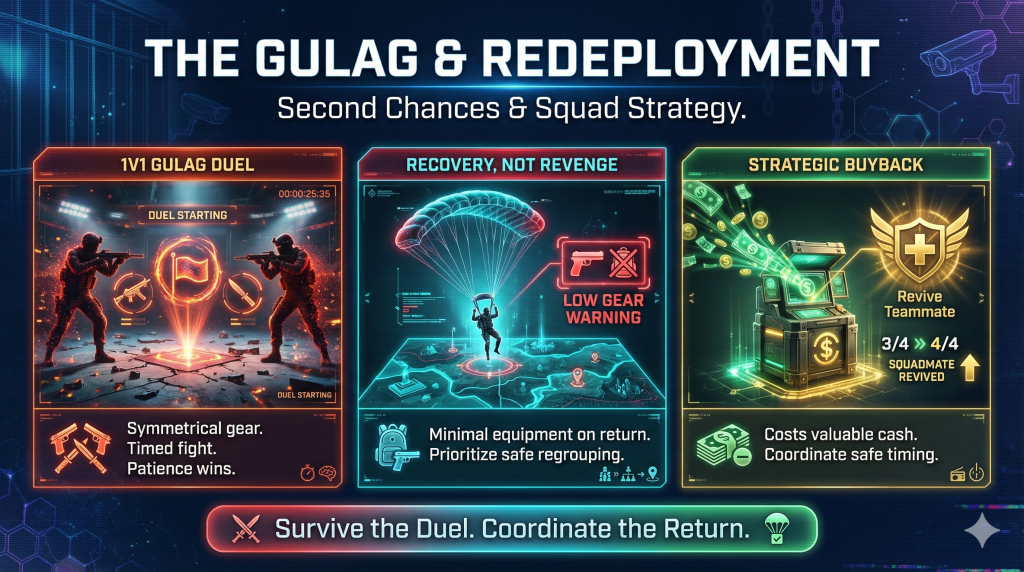
Elimination in Warzone does not always end your match. Your first death sends you to the Gulag, where a single duel determines whether you return to the game.
The Gulag is a limited opportunity, not a reset. Winning grants an immediate redeploy, but returning players re-enter the match with minimal equipment and little information about the battlefield.
Redeployment works best when treated as recovery, not revenge. After returning, your priority should be regrouping with your squad, re-equipping safely, and avoiding unnecessary engagements until you regain resources.
The Gulag rules
The Gulag is a one-on-one duel against another eliminated player. Both competitors receive the same random weapon and equipment, removing loadout advantages.
The fight is timed. If neither player secures a kill quickly, a flag appears in the center of the arena. Capturing the flag immediately ends the round.
Winning the Gulag favors patience and awareness. Listening for movement, using cover, and avoiding reckless pushes increases your chances of returning to the match. Losing the duel does not end your squad’s chances, but it does shift responsibility to your teammates.
Squad redeployment
If a teammate loses their Gulag fight, redeployment becomes a strategic choice. Buying a teammate back restores squad numbers, but it also consumes valuable cash that could be used elsewhere.
Redeployed players return with minimal equipment, making them vulnerable during the first moments after landing. Because of this, timing matters. Buying a teammate back when the area is unsafe often leads to repeated eliminations.
Effective squads coordinate redeployments carefully. The goal is to bring teammates back when there is time and space to regroup, re-loot, and restore armor before re-entering combat.
Survival strategy for the final circle
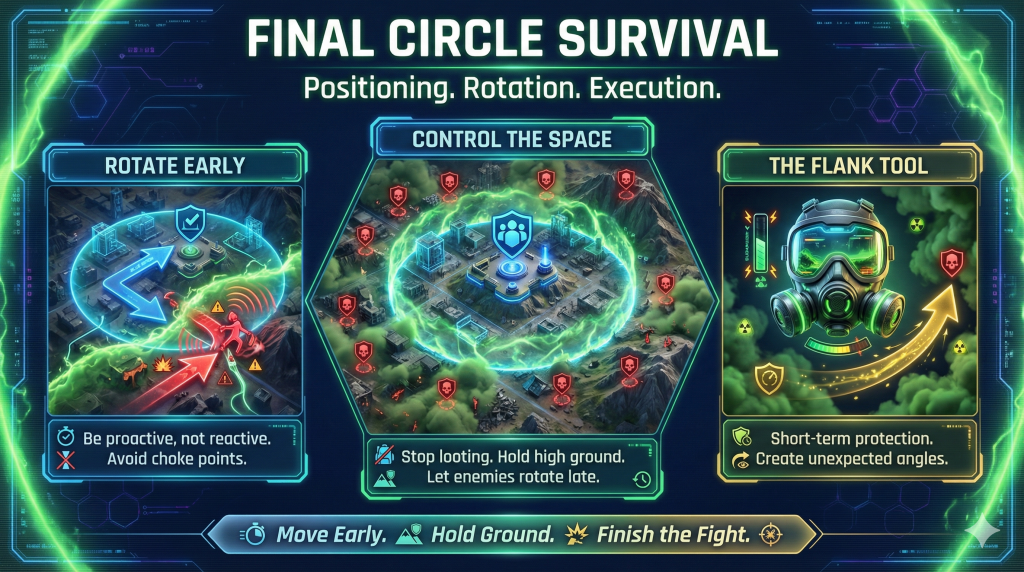
The final stages of a Warzone match are defined by limited space and incomplete information. As the safe zone shrinks, mistakes become harder to recover from and positioning outweighs raw gun skill.
At this stage, your priority should shift away from looting and toward controlling space. Strong positions, such as elevated terrain or solid cover near the center of the next circle, reduce exposure and limit the angles enemies can use against you.
Winning the final circle often comes down to patience. Letting other squads move first, forcing them into the open, and avoiding unnecessary pushes increases your chances of surviving the final engagements.
Rotating early
Rotation refers to moving from your current position into the next safe zone. The timing of this movement often determines whether you arrive safely or under pressure.
Rotating early allows you to choose safer paths, avoid crowded choke points, and secure strong positions before other squads are forced to move. This reduces the chance of being caught in open areas with limited cover.
Late rotations, by contrast, are reactive. When the gas forces movement, squads become predictable targets for enemies already holding favorable positions. Moving early trades speed for safety, which is a consistent advantage in Warzone.
The gas mask
A Gas Mask provides a short window of protection against the gas, allowing you to survive briefly outside the safe zone. Its value comes from timing, not endurance.
Used correctly, a Gas Mask creates unexpected movement options. It allows you to rotate through the gas to reposition, avoid direct sightlines, or delay your entry into the circle while other squads move first.
However, the Gas Mask is not a substitute for positioning. Overstaying in the gas drains resources and leaves you vulnerable once the mask breaks. Treat it as a tool for controlled movement, not a fallback for poor planning.
Conclusion
Winning your first Warzone match is less about mechanical dominance and more about surviving long enough to make the right decisions. Understanding how systems like the gas, armor, economy, and redeployment interact gives you control over situations that often feel chaotic to new players.
Strong matches are built on preparation rather than aggression. Managing resources, securing safe positioning, and choosing when to engage or disengage consistently matter more than chasing early eliminations.
As you gain experience, these decisions become instinctive. By focusing on survival fundamentals and disciplined movement, you give yourself repeated opportunities to reach the final circle and convert consistency into your first victory.
Frequently Asked Questions
Is Warzone free to play?
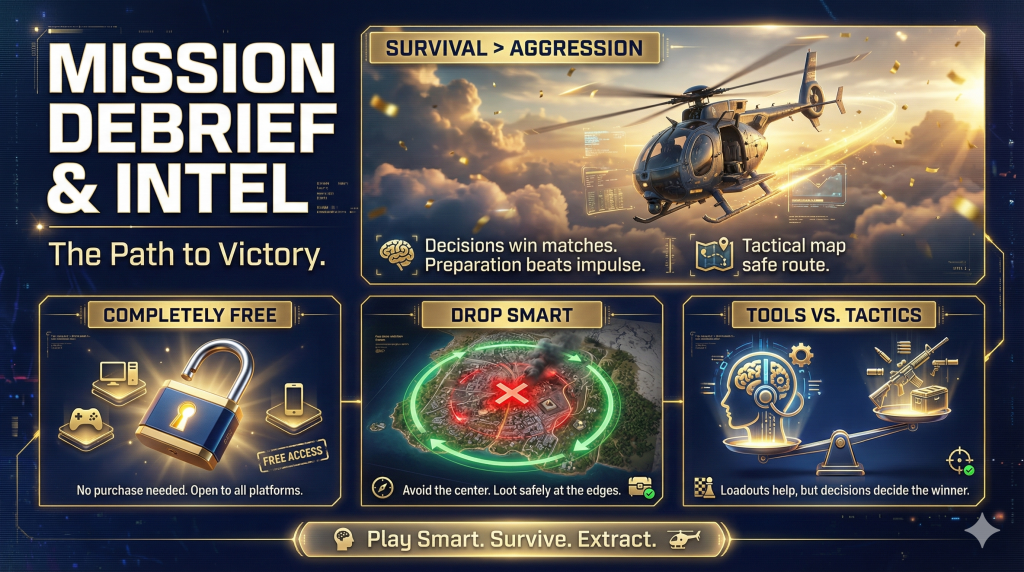
Yes. Warzone is completely free to download and play on PlayStation, Xbox, and PC. You do not need to purchase a full Call of Duty title to access the Battle Royale mode.
Do you need a console subscription to play Warzone online?
In most cases, no. Major console platforms allow free-to-play games like Warzone to be played online without an active subscription, though policies can vary by region and platform.
Where should beginners drop at the start of a match?
New players should avoid areas directly under the plane’s flight path, as these attract aggressive squads. Landing near the edge of the map provides more time to loot, gather cash, and complete contracts with lower risk.
Is getting a loadout always necessary to win?
Loadouts greatly improve consistency, but they are not a guarantee of success. Smart positioning, resource management, and survival decisions still determine whether a match reaches the final circle.


0 Comments