Introduction
In Elden Ring, having high stats does not guarantee you will be powerful. A Level 150 character with random equipment will struggle against bosses that a Level 60 character with a focused build can destroy in seconds. A true “Build” is a mathematical synergy between your Weapon, your Talismans, and your primary Damage Stat.
This guide skips the experimental setups and focuses on the three absolute strongest loadouts that have dominated the meta since launch. Whether you are just starting in Limgrave or preparing to burn the Erdtree, these are the blueprints for success.
Key Takeaways
- Vigor is your difficulty slider. Getting Vigor to 40 is more important than any damage stat in the early game.
- Weapon Level > Stats. Your damage comes primarily from upgrading your weapon, not your Strength or Dex score.
- Soft Caps matter. Stopping at 60 Vigor or 80 Intelligence prevents you from wasting levels on diminishing returns.
- Bloodhound’s Fang is the king of the early game because it can be acquired within 20 minutes.
- Blasphemous Blade provides infinite healing, making it the best build for long dungeons.
Affiliate Disclaimer: Some links on this site are affiliate links. If you buy through them, we may earn a small commission, at no extra cost to you. Please do your own research before making a purchase.
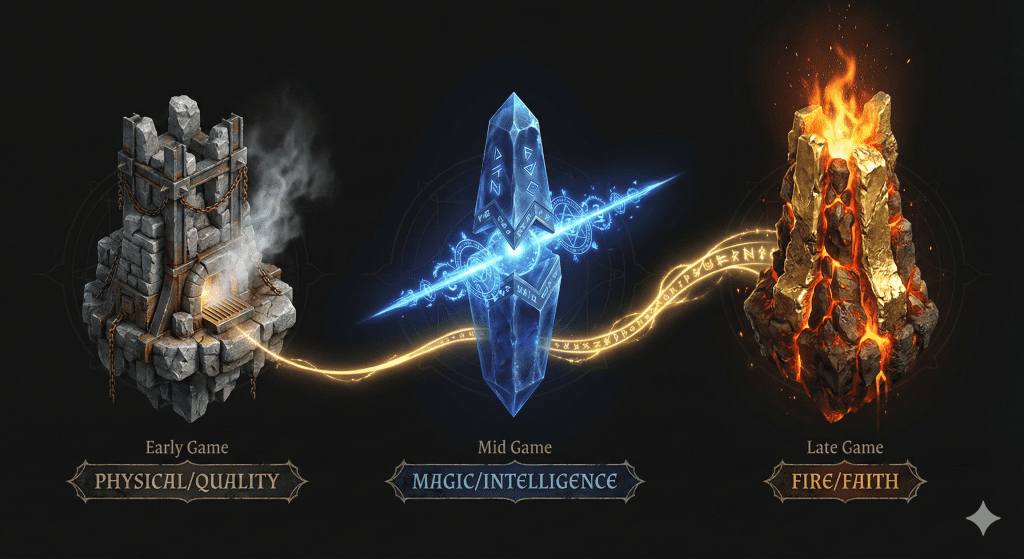
The Best Early Game Build: The Bloodhound Knight
The early game is defined by a lack of resources. You do not have access to high-level spells or infinite mana potions.
Therefore, the best strategy is a “Quality” build that relies on physical damage and a weapon that hits hard without needing complex buffs.
This build revolves around a curved greatsword that can be acquired immediately after the tutorial.
The Weapon: Bloodhound’s Fang
The Bloodhound’s Fang is arguably the best early-game weapon in Elden Ring. You can find it by defeating the boss in the “Forlorn Hound Evergaol” in southern Limgrave.
- Why it wins: It is a “Somber” weapon, meaning it is upgraded with Somber Smithing Stones. These are much easier to find early on than standard stones. You can realistically get this weapon to +4 (equivalent to a +10 standard weapon) before you even enter Stormveil Castle.
- Bonus: It deals innate “Bleed” damage, which takes huge chunks of health off bosses.
Stat Priority
Your damage stats do not matter much until your weapon is upgraded. Your priority is survival.
- Vigor to 30: Do this immediately. It prevents you from getting one-shot by bosses like Margit.
- Endurance to 15: Enough to swing the sword and dodge.
- Dexterity: Once you are safe, pump everything into Dexterity to scale your damage.
The Ash of War: Bloodhound’s Finesse
The true power of this build lies in the weapon’s unique skill. Pressing L2 performs an upward slash and an automatic backflip. This backflip has “invincibility frames,” meaning you can use it to dodge through an enemy attack while dealing damage. Pressing R2 immediately after the flip triggers a teleport-dash attack forward. Mastering this combo allows you to dance around enemies while dealing massive damage.
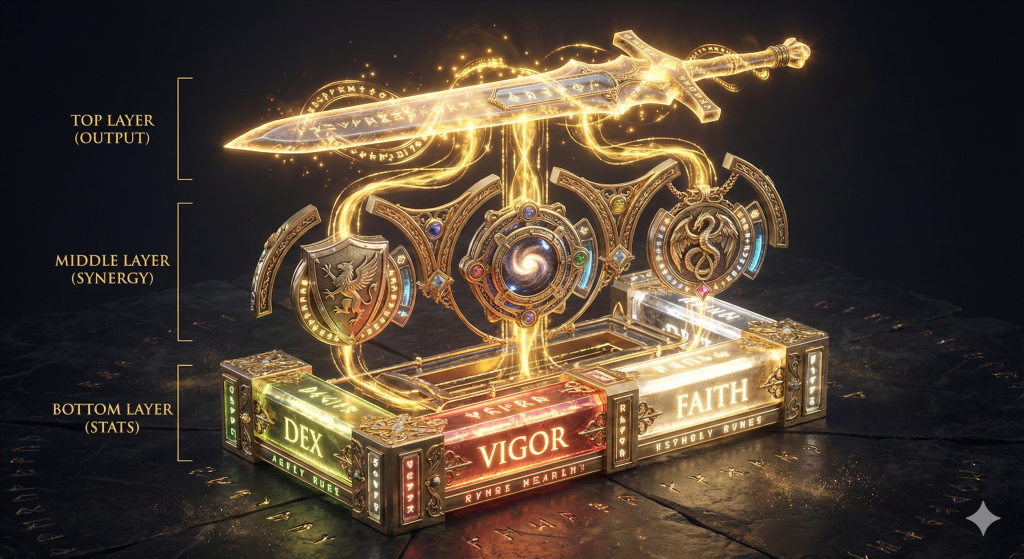
The Best Mid-Game Build: The Moonveil Samurai
Once you reach Liurnia and Caelid, you gain access to powerful sorceries. Pure mage builds can be difficult to manage because of FP (mana) costs, but a “Spellblade” hybrid solves this problem.
This build combines the speed of a katana with the power of magic. It allows you to shoot enemies from a distance and slash them when they get close.
The Weapon: Moonveil Katana
The Moonveil is located in Gael Tunnel on the border of Caelid. It scales with both Intelligence and Dexterity.
- Why it wins: Its Ash of War, “Transient Moonlight,” sheathes the blade and then releases a wave of magic energy. This attack comes out almost instantly and deals massive “Poise” damage. Two or three hits will stagger almost any boss in the mid-game, allowing you to perform a critical strike.
Stat Priority
You are shifting from a physical fighter to a magic user.
- Intelligence to 50: This is your primary damage stat. It increases the damage of your katana’s magic wave and your spells.
- Vigor to 40: Mid-game bosses hit harder. You need the health buffer.
- Mind to 20: You need a larger FP bar to use your weapon art frequently.
Synergy: The Meteorite Staff
Since you are leveling Intelligence for the katana, you should also carry a staff in your off-hand. The Meteorite Staff (found in the Caelid swamp) is the best option because it has excellent scaling and requires no upgrades.
Pair this with the spell Rock Sling. Rock Sling deals physical damage, which is perfect for killing enemies that are resistant to the magic damage of your Moonveil.
Here is the guide for the build that makes the endgame significantly easier.

The Best Late Game Build: The Blasphemous Paladin
As you approach the Mountaintops of the Giants and Farum Azula, enemies deal absurd amounts of damage. The best counter to high damage is high healing. This build turns your character into an unkillable tank that heals every time you attack. It relies on the Faith stat, which gives you access to defensive buffs and the most broken weapon in the game.
The Weapon: Blasphemous Blade
You obtain this greatsword by trading the Remembrance of Rykard at the Roundtable Hold. It scales primarily with Faith and Strength.
- Why it wins: The Ash of War, “Taker’s Flames,” shoots a wave of fire along the ground. If this fire touches an enemy, you are instantly healed for a large portion of your health. It also heals you passively whenever any enemy dies nearby. This eliminates the need to drink healing flasks during long dungeon runs.
Stat Priority
You need high Faith to maximize the fire damage and the healing return.
- Faith to 60: This hits the soft cap for weapon damage and incantation scaling.
- Strength to 30: Enough to wield the weapon effectively.
- Vigor to 60: Late-game bosses have attacks that can deal 1500+ damage. You need the maximum health pool to survive.
Essential Buffs
Since you have high Faith, you should always cast two spells before a boss fight:
- Golden Vow: Increases your damage and defense for 80 seconds.
- Flame, Grant Me Strength: specifically boosts physical and fire damage. Since the Blasphemous Blade deals both, this one spell creates a massive damage multiplier.
The “Meta” Bleed Build: Rivers of Blood
If you prefer speed over tankiness, the “Bleed” archetype is the strongest offensive option. This build focuses on the Arcane stat to trigger the “Hemorrhage” status effect. When Hemorrhage triggers, it deals damage equal to a percentage of the boss’s total health. This makes it the most effective strategy against enemies with massive health bars, like the Fire Giant or Malenia.
The Weapon: Rivers of Blood
Found at the Church of Repose in the Mountaintops of the Giants, this katana is infamous for a reason. Its unique skill, “Corpse Piler,” unleashes a flurry of blood slashes that hits enemies from a distance.
- Stat Split: Prioritize Arcane (50) and Dexterity (45).
- Synergy: Equip the Lord of Blood’s Exultation talisman. This item boosts your attack power by 20% whenever a bleed effect occurs nearby. Since you are causing bleed constantly, the damage buff is permanently active.

Conclusion
There is no single “best” build that solves every problem in Elden Ring. The beauty of the game is that it gives you the tools to adapt. If you are stuck on a fast, aggressive boss like Maliketh, the slow swing of a Greatsword might be your downfall. Switching to a faster Katana or a ranged magic build could be the solution.
Remember to use your “Larval Tears” at Raya Lucaria Academy to experiment. If you find a new weapon you want to try, don’t be afraid to reset your stats and build around it.
Finally, do not ignore your Spirit Ashes. The Mimic Tear summon creates a copy of your character, effectively doubling the power of whatever build you choose.

Frequently Asked Questions
How do I reset my stats?
You must defeat Rennala, Queen of the Full Moon, at the Academy of Raya Lucaria. Once she is defeated, you can speak to her and choose “Rebirth.” This costs one Larval Tear. There are only about 18 Larval Tears in a single playthrough, so spend them wisely.
What are Soft Caps?
A “Soft Cap” is the point where putting more points into a stat gives you diminishing returns.
- Vigor: The first cap is 40, and the second is 60. Never go past 60.
- Endurance: Stamina gains stop at 50.
- Damage Stats (Str/Dex/Int/Fth): The major caps are at 60 and 80. Stopping at 80 is usually the most efficient use of points for a dedicated build.
Is Magic better than Melee?
Magic is generally safer and easier for beginners because it allows you to fight from a distance. However, melee builds are often more reliable in the endgame because they do not rely on a limited pool of FP (mana). The strongest builds, like the Moonveil Samurai, use a hybrid of both to get the best of both worlds.



0 Comments