
Forget What You Knew
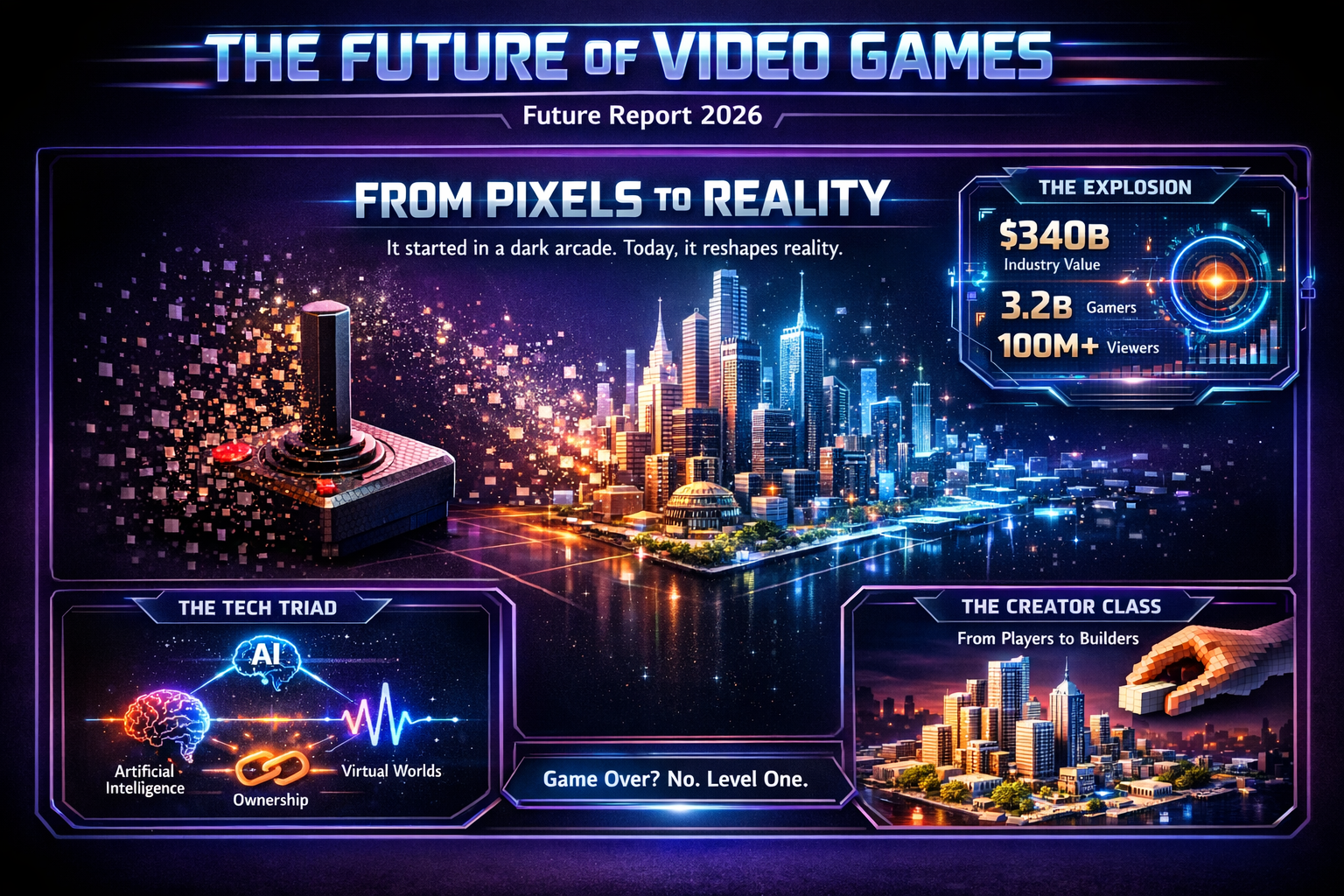
It started in dimly lit arcades with a joystick, a CRT monitor, and a local high score. In 2026, interactive entertainment is the dominant cultural infrastructure on Earth, shaping how humanity socializes, tells stories, builds economies, and trains artificial intelligence.
If you still view video games merely as "pastime entertainment," you are looking in the rearview mirror. Gaming is now the primary third place for a connected world.
The 2026 Macroeconomic Shift
SOURCE: GLOBAL INTERACTIVE BENCHMARKS 2026
640M+
Global Live Esports & Event Audience
Championship finals in League of Legends, Valorant, and Mobile Legends routinely draw over 100M+ concurrent live viewers, surpassing the NBA Finals.
$365B
Projected Ecosystem Valuation
Propelled by blockbuster launches, cloud-native streaming, and hardware-agnostic ecosystems, gaming now generates more revenue than film and music combined.
3.42B
Active Players Worldwide
Over 42% of the human population actively plays video games in 2026, spanning across mobile devices, next-gen handhelds, PCs, and living room consoles.
“Gaming didn’t just join mainstream culture; it became the operating system for how modern culture is distributed across music, fashion, cinema, and social identity.”
Why We Play
(And Why Interactive Stories Move Us)
Winning a match is secondary. Agency and emotional resonance are everything.
The Last of Us wasn’t merely a survival game; it was a profound examination of love and grief. Red Dead Redemption 2 was an elegy on loyalty and time. And in recent years, works like Baldur’s Gate 3, Alan Wake 2, and Clair Obscur: Expedition 33 proved that branching player agency creates an emotional weight passive cinema cannot replicate.
“At their heart, games differ from other media in one fundamental way: they offer players the chance to influence outcomes through their own efforts.”
The Tech Shaping Reality in 2026
Select a pillar below to explore how hardware and software breakthroughs have matured from experimental prototypes into live production.
Agentic & Generative AI Systems
In 2026, artificial intelligence in gaming has evolved far beyond pre-scripted dialogue trees. Autonomous NPCs now possess persistent episodic memory, dynamic emotional states, and unscripted voice synthesis, allowing worlds to organically reshape around your exact reputation and playstyle.
“From early pioneers like Shadow of Mordor’s Nemesis System to 2026’s on-device NVIDIA ACE & Inworld neural models, characters now negotiate, form alliances, and remember every promise you break.”
The Rise of the Gamer-Creator Class
The studio gatekeepers no longer hold a monopoly on world-building. Platforms like Unreal Editor for Fortnite (UEFN), Roblox, and modding ecosystems have turned players into funded studios, distributing over $1.5B+ annually to independent builders.
From Playing to Earning
Creator PayoutsIndependent developers and small teams in their late teens and twenties are building six- and seven-figure studios inside existing game ecosystems, testing mechanics with millions of live players overnight.
Co-Creation Over Consumption
68% Gen-Z / AlphaNearly 7 in 10 younger players in 2026 prioritize games where they can customize rules, design cosmetics, or monetize their own community servers rather than passively consuming static campaigns.
The Mobile & Global South Revolution
-
01
2.1 Billion+ Mobile & Handheld Players With hardware-accelerated ray tracing on modern smartphones and handheld PCs, AAA fidelity fits in every pocket in 2026.
-
02
55%+ of Global Interactive Revenue Cross-progression titles allow players to seamlessly switch between desktop rigs and mobile devices without losing progress.
-
03
New Cultural Power Centers Rapidly expanding studio hubs and esports arenas in Brazil, Nigeria, Indonesia, India, and the MENA region are setting global trends.
“If you still assume the most competitive players and boldest creative studios only come from Silicon Valley or Tokyo, you’re missing the biggest story of 2026.”
GAME OVER?
NO. STILL LEVEL ONE.
Gaming isn’t an escape from reality. It is the sandbox where the next reality is prototyped. It is where digital empathy is forged, distributed leadership is practiced, and the future is rehearsed.
The architects building tomorrow are already online. And they’re playing right now.